
Most people who start a service business do it because they were good at a trade. Cleaning, landscaping, HVAC, handyman work. The specifics vary, but the story is usually the same. Someone skilled decided to go out on their own, built a client base through hard work and reputation, and ended up with a business that depends entirely on their presence to function.
While having your own business is an amazing experience, it can be tiring to run everything on your own. A business where the owner handles every job, every call, and every decision can only grow as far as one person's time and energy allows. Getting past that ceiling means building something that operates on systems and people, not just on the owner's effort.
In this article we’ll explore how service businesses can do that.
Service Business Management: How to Make Your Business Independent
Most service businesses start with one person doing everything from the work, the scheduling, and the client communication to the invoicing. It works at first because the operation is small enough for one person to manage without much structure.
The trouble is that many owners never change that structure as the business grows. They take on more work, hire one or two helpers, but never document how things should be done or give anyone real decision-making authority. It's easy to fall into this trap because you get used to doing things this way, but it can set you and your business back.
At that point, the business has a hard limit on how far it can grow. More revenue requires more hours from the owner, time off creates problems because nothing moves without their input, and the long-term value of the business suffers because buyers won't pay a premium for something that only functions when one specific person is present. Here’s some steps you can take to make your service business more independent:
1. Getting Processes Out of the Owner's Head
The first step is extracting the accumulated knowledge that lives in the owner's head and turning it into something the rest of the team can actually use.
Think about how an experienced owner approaches a job. The order they check things on a site. How they handle a new client's first call. The way they decide what to charge for an unusual request. How they deal with a complaint. Most of that knowledge was built over years of experience and exists nowhere except in the owner's mind, which means no one else can replicate it without constant guidance.
Documenting processes doesn't have to be complicated. Writing down the steps for the most common jobs, creating a checklist for what a completed job should look like before the team leaves, recording a short walkthrough video for a new hire. These are all straightforward things that pay off significantly over time. The goal is giving someone else enough information to do the work to a consistent standard without needing to ask at every turn.
2. How to Hire the Right People for Your Business? Character Over Technical Skill
When service business owners start hiring, the instinct is usually to focus on technical ability. Whether a candidate can actually do the work matters, but the people who help a business grow beyond the owner are almost always the ones who take ownership of their work, communicate honestly, and hold their own standards even when no one is watching.
Technical skills can be trained. Work ethic and integrity are much harder to develop in someone who doesn't already have them. And although there are many things you need to take into account when hiring a candidate; such as these recruitment strategies suggested by Indeed, integrity and work ethic are very important to look for because as a small business owner you'll be working very closely with the people you hire.
Here are some helpful tips to get to know a candidate’s work ethic:
- Spend as much time on how a candidate thinks and handles problems as on their qualifications.
- Ask about a time something went wrong on a job and how they handled it
- Ask what they'd do if a client wasn't satisfied with their work.
Once good people are in place, it's worth investing in them properly. Teaching the reasoning behind processes, not just the steps, gives team members enough context to make sound decisions independently. People who understand why something is done a certain way are more reliable than people who are just following instructions without that background.

3. How to Improve Company Growth: Build a Simple Management Layer
A service business doesn't need a complicated organizational structure to run well without the owner, but it does need someone besides the owner who is responsible for the day-to-day.
As a team grows, identifying the strongest performer and giving them real authority is an important step. This person becomes the point of contact on jobs, solves problems in the field before they need to escalate, and holds the team to the standards the owner has set.
This is the step that many owners struggle with most, because it requires letting go of direct control. Things will sometimes be handled slightly differently than the owner would handle them personally. What matters is that the outcome stays consistent: a satisfied client and a job done correctly.
If the team lead still has to call the owner for approval on every small issue, the owner hasn't actually stepped back. They've just added a layer of delay without gaining any real capacity.
4. How the Right Tools Take Admin Work Off Your Plate
A large part of what keeps service business owners tied to their operation every day isn't the actual work. It's the administrative load: scheduling, invoicing, following up on quotes, tracking jobs, communicating with clients. All of it takes time, and most of it can be streamlined significantly with the right tools.
Job management platforms allow work to be assigned and tracked without phone calls back and forth. Scheduling tools handle booking without manual coordination. Automated follow-ups handle appointment reminders and review requests after a completed job. Payments process online without chasing anyone down.
Platforms like uSource Enterprise are built specifically for service business management and handle a lot of this out of the box, managing job flow, keeping client communication in one place, and connecting businesses with new clients. When administrative work stops consuming hours every day, there's time to focus on decisions that actually move the business forward.
5. Building a Service Business that Runs Without You: Setting Standards and Stepping Back
Once documented processes, trained people, a management layer, and the right technology are in place, the last part of the equation is trusting the system that's been built.
This doesn't mean you won't pay attention to your business any longer, it just means your business will run smarter and the work will be better distributed, it also means you’ll be able to scale. Here are some ways to keep the system you’ve built in check:
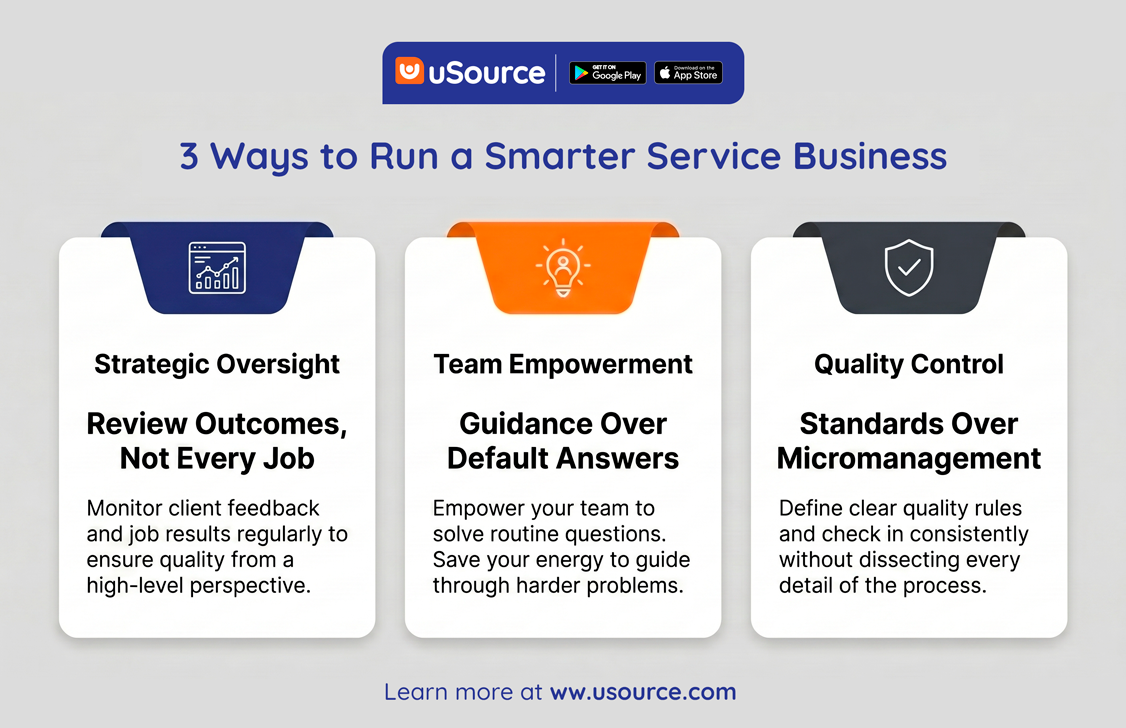
- Reviewing job outcomes and client feedback regularly without being present at every job.
- Being available to the team for guidance on harder problems without being the default answer for every question.
- Setting clear quality standards and checking in on them consistently, without micromanaging every detail of how the work gets done.
The owner's role shifts at this stage. Instead of doing the work, the focus moves to leading the people who do the work, improving the systems, and making the decisions that genuinely require ownership-level judgment: which markets to pursue, which services to add, when and how to grow the team.
Building Something Worth Having
The common thread running through every step of this process is the same: moving the business from depending on one person to running on systems, people, and the right tools working together. Documentation gives the team a foundation to work from. Good hiring puts capable people in place to use it. A clear management layer keeps things moving without the owner in the middle of every decision. And the right technology handles the administrative work that would otherwise consume hours every day.
That's where platforms like uSource become genuinely useful. For service businesses at any stage of growth, uSource handles the operational infrastructure that used to require constant owner involvement, connecting businesses with clients, managing job flow, keeping communication organized, and supporting teams in the field. Schedule a meeting with us and we’ll get you started with all the right tools to get your business to the next level.